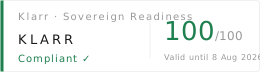
Klarr tells you exactly where your organisation stands under the EU AI Act — which tools you use qualify as AI systems, what obligations apply, and what to fix before August 2, 2026.
Not every tool with "AI" in the name qualifies — and some that don't will. Klarr walks you through a structured intake: what the system does, who it affects, and whether it meets the EU AI Act definition under Article 3. No legal background required.
Klarr maps each system against the EU AI Act annexes. Prohibited, high-risk, GPAI, or minimal — with the specific articles and documentation obligations that apply to your situation.
Monitor progress across eight compliance dimensions. Export board-ready reports. Assign tasks to owners. Know your readiness stage at any moment — and what it takes to advance.
| System name | Vendor | Risk tier | Stage | Open tasks |
|---|
Your full compliance picture — every system, every obligation, every open task — visible from day one.
EU AI Act compliance is not a one-time legal review. It requires continuous inventory management, classification, task ownership across business units, board reporting, and post-market monitoring — for every AI system you deploy.
Most enterprises approaching this today are doing so with a combination of external consultants, legal hours, and internal coordination that was never designed for this regulation. That approach costs more, takes longer, and produces documentation that requires yet another round of review to be audit-ready.
Klarr replaces that process. The cost comparison is not with other SaaS tools. It is with the alternative.
Based on EU market consulting day rates. Your costs will vary. The direction will not.
For startups, SMEs, and any organisation that needs to answer their board or investors on AI Act exposure — without an enterprise budget.
For growing organisations with multiple AI tools, a legal or compliance function, and a board that expects answers.
For complex organisations requiring tailored assessment, workshop delivery, and ongoing advisory.
Know where you stand before your board, your investors, or a regulator asks. Request access — or reach us directly.